100k Orders
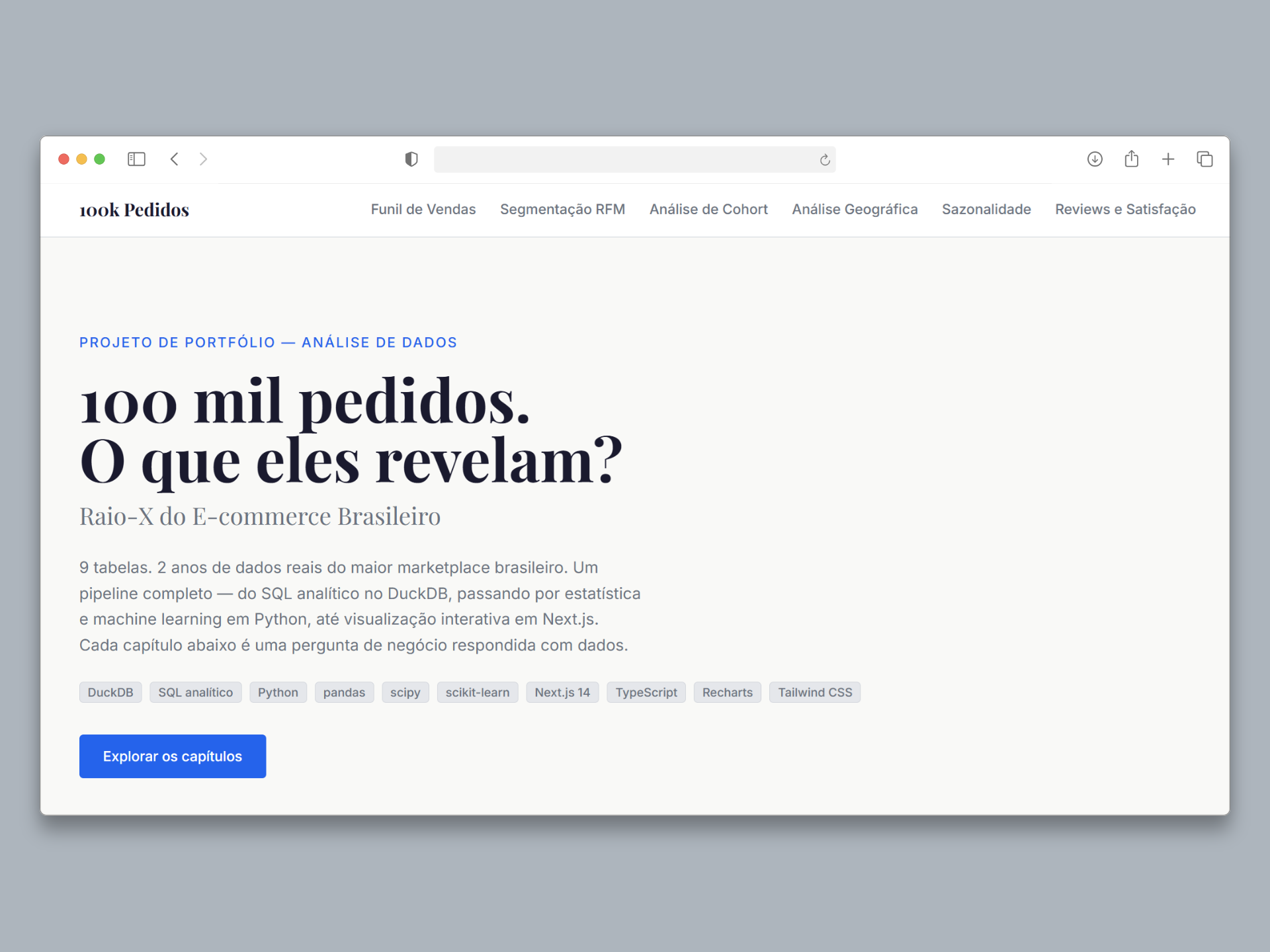
Interactive dashboard analyzing the Olist dataset of 100,000 Brazilian e-commerce orders, with statistical, geographic, and predictive analyses.
- DuckDB
- Python
- scipy
- scikit-learn
- statsmodels
- Next.js 14
- Recharts
- Leaflet
- Tailwind CSS
- Cloudflare Pages
Context
The Olist dataset on Kaggle is one of the most comprehensive datasets on Brazilian e-commerce: 100,000 real orders with customer, seller, product, review, and geolocation data. It’s widely used in data portfolios, but most analyses stay on the surface — basic bar charts and descriptive statistics.
The Problem
How to go beyond superficial analysis and extract insights that would actually be useful for an e-commerce operation, presenting everything interactively and accessibly?
Technical Decisions
- DuckDB as the analytical engine — SQL processing directly on files, no database server
- Python with scipy, scikit-learn, and statsmodels for statistical and predictive analyses
- Next.js 14 for the interactive frontend
- Recharts for charts and Leaflet for geographic maps
- Tailwind CSS for styling
- Cloudflare Pages for deployment
I chose DuckDB over pure pandas for performance in complex analytical queries and familiar SQL syntax.
The Process
The analysis was divided into progressive layers:
- Descriptive — order distribution, seasonality, average ticket by category
- Geographic — heatmap of sellers and customers, regional concentration, freight analysis by distance
- Statistical — hypothesis testing, correlations, customer segmentation
- Predictive — delivery delay and customer satisfaction prediction models
The frontend was built as a multi-tab dashboard, each telling part of the story. The Leaflet map was particularly challenging due to the number of data points (optimized with clustering).
The project has 373 automated tests (253 Python + 120 frontend), ensuring analyses are reproducible and the dashboard works correctly.
The Result
A complete dashboard with descriptive, geographic, statistical, and predictive analyses. Over 15 interactive visualizations including maps, scatter plots, and time series. Test coverage above 80%.
Lessons Learned
- DuckDB is incredibly efficient for exploratory analysis — data warehouse performance without the complexity
- Interactive maps with many points need optimization (clustering, lazy loading)
- Dividing analysis into progressive layers (descriptive → geographic → statistical → predictive) creates a more convincing narrative than throwing everything together
- 373 tests might seem excessive for a portfolio project, but they ensured refactoring didn’t break anything